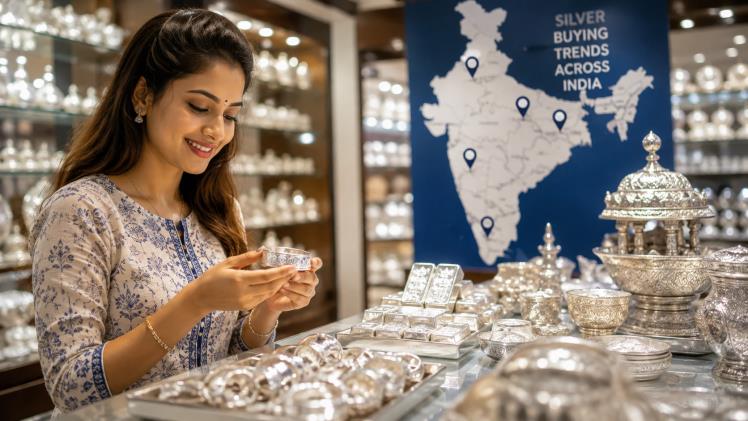
Households looking up the silver rate today ahead of a festival purchase often follow a similar routine to those checking the silver rate today in Delhi, where the city’s markets have long served as a benchmark for silver pricing trends felt across much of northern India. Silver’s appeal lies in its accessibility, allowing families across income levels to participate in traditions that might otherwise feel out of reach with gold alone. Looking beyond the daily number, it becomes clear that silver buying in India is shaped by a rich mix of history, craftsmanship, and evolving consumer habits that deserve closer attention.
The Craftsmanship Behind Silver Jewellery and Artefacts
Silver has always been a preferred medium to showcase intricate craftsmanship in various parts of India. Filigree work, oxidised finish, and special engravings are some of the unique features that set Indian silver apart. These age-old skills have been perfected by local artisans over centuries, resulting in exquisite pieces of work. The value of such handicraft often enhances the price of the silver articles beyond the theoretical value of the metal. Thus, while calculating the value for silver items, it is important to consider the extra effort that might have gone into making the item.
In comparison to cheaper imitations, a handicraft item may involve special engraving and filigree work, which enhances the value of the silver piece manifold. Therefore, such items may cost significantly more than a machine-made silver bangle. Buyers need to consider this differential while making their purchase decisions. In a country like India, which is steeped in tradition, silver holds immense value as a gift item.
Silver as a Gift Item
Silver coins with religious motifs are mainly gifted on auspicious occasions like childbirth and housewarming. Apart from gold, silver coins and utensils are also presented as gifts to mark the birth of a child. This tradition further adds to the demand for silver as compared to gold, which is mostly bought for weddings and special occasions. While corporate gifting in India also includes gold items, silver is preferred as a memento and is distributed as a part of holiday celebrations. Thus, the demand for silver in India not only comes from individual buyers but also from corporates, which enhances the demand for silver throughout the year.
The demand-supply pattern and the impact on the price of silver is dictated by industrial demand, apart from the investment demand. Unlike gold, the industrial demand for silver has a significant impact on the price. The industrial sector in India is witnessing growth and is in need of silver for various electronic appliances. Further, renewable energy is gaining ground and silver is a key component due to its conductivity. Therefore, apart from investment and personal use demand, the industrial demand in India also impacts the price of silver.
Impact of Currency Movements on Silver Price
Just like gold, currency movement also influences the price of silver. A weaker currency will impact the price of silver in India.
Since silver is traded in smaller denominations as compared to gold, the price may appear to move faster in comparison to the value of gold. Therefore, it is important to analyze and track the price on a month on month or a year on year basis instead of looking at the day to day or week on week basis.
Silver Coins, Bars and Jewellery – Which One is a Better Buy?
Coins and bars have always been a preferred mode of investment as compared to jewellery. For an individual who is looking to make a substantial purchase of silver as a part of their investment portfolio, jewellery will not be a good value option due to the making charges. Unless the intrinsic value of the jewellery is the same as the value of coins, it is better to go with the latter as an investment option.
However, for a buyer who is looking to buy silver as a part of their personal collection or for gifting purposes, silver jewellery may be a better option. It is important to keep in mind that making charges and designing costs have an adverse impact on the resale value. Therefore, unless the individual intends to hold on to the jewellery for a long time, it is better to avoid buying jewellery as an investment due to high chances of loss on resale.
Tips to Buy Silver in India
It is important for the buyer to demand a breakup of the amount charged for the silver items. Buyers must remember that making charges and taxes on silver items can enhance the final price manifold. By demanding a breakup of the charges, the buyer may ensure that he is not being charged extra. Checking the purity of the silver content is also an important step while buying silver in India.
By cross checking the purity of various items on display, the buyer can have a rough idea of the value of silver that he may be buying. It is always advisable to check rates with various suppliers and compare not just the rate per gm but also the making charges. This is particularly important for high value items such as sets or bars. Proper maintenance of the silver items in appropriate storage will help the buyer to maintain the value of the item. Keeping the receipts and the certificate of purity is also essential to facilitate future sales or exchanges.
Silver has always been an important metal in India due to its intricate craftsmanship, its value as a gift item, and also because it provides an opportunity for small-scale investments. While the unique cultural aspect has enhanced the appeal of silver, buyers need to keep in mind various parameters like purity, making charges and proper maintenance to maximise their benefits while buying silver.